


PFAS in Stuffed Toys: What Babies Are Absorbing
TL;DR:
- Stuffed toys made with stain- or water-resistant treatments can release PFAS ("forever chemicals") into saliva during mouthing, a primary exposure route for babies and toddlers.
- GOTS-certified organic cotton and natural rubber stuffed animals are the safest alternatives currently available.
- You do not need to throw out every toy at once. Start by swapping the toys your baby mouths most often.
Key Takeaways
- A peer-reviewed study found that stuffed toys release short-chain PFAS compounds, including PFHxA (perfluorohexanoic acid), directly into artificial saliva under mouthing conditions, with infants estimated to mouth toys for approximately 0.77 hours per day.
- A 2024 review published on NCBI linked early-life PFOA exposure to nearly a fourfold increase in certain neurodevelopmental outcomes, confirming why reducing mouthed-toy PFAS exposure is a meaningful intervention.
- GOTS-certified organic cotton stuffed animals, such as those from Under the Nile, are the most accessible, budget-friendly starting point for reducing PFAS exposure from toys, with no stain-resistant fabric treatments required.
Is There Really a Reason to Worry About Stuffed Toys?
Yes — and mouthing is the reason it matters. Most parents researching non-toxic living focus on food, cleaning products, and skincare. Stuffed animals feel safe by comparison. They're soft, they're cozy, and they don't look like a chemical product. That intuition makes sense, but it misses something important: babies mouth their stuffed toys constantly, and mouthing is one of the most direct chemical exposure routes there is.
If your baby spends part of every nap clutching a plush toy against their face, or gnawing on a stuffed elephant during teething, that toy's fabric treatment is going directly into their system. The research on this is newer than most parents realize, and it's worth understanding.
What Are PFAS, and Why Are They in Stuffed Toys?
PFAS, or perfluoroalkyl and polyfluoroalkyl substances, are a large family of synthetic chemicals that resist heat, grease, stains, and water. They've been used in consumer products since the 1950s. When you see "stain-resistant," "water-resistant," or "easy-clean" on a fabric product, PFAS is often what makes that possible. HealthyChildren.org (AAP) describes PFAS as a large family of human-made chemicals found in many consumer and commercial products, noting their durability is precisely what makes them a concern.
They're called "forever chemicals" because they don't break down in the human body or in the environment. Exposure is associated with immune system disruption, hormonal interference, liver and kidney damage, and developmental delays in children. The FDA's PFAS overview documents that certain PFAS are associated with effects on the immune system, thyroid, liver, and reproductive development, particularly at early life stages.
The reason stuffed toys matter here: some plush fabrics are treated with PFAS to make them stain-resistant or to achieve a certain texture. That treatment can migrate out of the fabric when it comes into contact with saliva, which is exactly what happens during mouthing.
What this means for your family: The toy that feels the softest may have the most fabric treatment. "Easy to wipe clean" is a phrase worth reading carefully on a toy label.
What Does the Research Actually Say About Babies Mouthing Stuffed Toys?
A 2021 study by Sookrunning et al., published in Environmental Science & Technology, found that multiple stuffed toys released measurable short-chain PFAS compounds into artificial saliva under mouthing conditions. PFHxA (perfluorohexanoic acid) was the highest contributor to estimated weekly intake, particularly in toys with elevated PFAS content. The researchers used a mouthing frequency of 0.77 hours per day for infants, consistent with what the published literature documents for this age group.
The concern isn't one dramatic exposure event. It's the cumulative daily dose from a toy that's in a baby's mouth for portions of every single day.
A recent review of early-life PFAS exposure and child neurodevelopment connects specific PFAS compounds like PFOA to attention, cognitive, and behavioral concerns. A 2025 review in Current Environmental Health Reports summarizes the growing body of evidence linking early-life PFAS exposure to child neurodevelopmental outcomes.
A 2026 study published in Environmental Science & Technology found that babies born between 2003 and 2006 were exposed to far more forever chemicals before birth than scientists previously understood, reinforcing that prenatal and early postnatal exposure windows are especially consequential.
What this means for your family: PFAS exposure from stuffed toys adds to an already significant total body burden that starts before birth. Reducing mouthed-toy exposure is a meaningful lever parents can actually pull.
Which Babies Are Most Vulnerable to PFAS From Toys?
All infants in the oral-fixation stage are at elevated risk, but the younger and smaller the baby, the greater the proportional exposure. All infants explore objects with their mouths from roughly four months through the toddler years, and during teething this intensifies significantly. Babies are more vulnerable than adults to PFAS for two documented reasons: their body-weight-normalized intake is higher, meaning they absorb more relative to their size; and their developing hormonal and neurological systems are more sensitive to disruption at lower doses.
National biomonitoring data summarized by the NIEHS confirms that PFAS have been detected in the blood of people across all age groups in the US — a CDC analysis using NHANES data found PFAS in the blood of 97% of Americans — with infants and young children representing a particularly sensitive population due to rapid organ development during this window.
SCRUNCHY MOM TIP: During the heavy-mouthing and teething phase, lean into toys made of natural rubber and GOTS-certified organic cotton. These materials don't require stain-resistant fabric treatments and hold up well to repeated washing.
What Materials Are Actually Safe in Stuffed Toys?
This is where parents often feel overwhelmed, so here's a straightforward breakdown.
What to Avoid
- Plush toys with stain-resistant, water-resistant, or "easy-clean" fabric treatments — these are the most likely to carry PFAS, which can migrate into saliva during mouthing.
- PVC and vinyl soft toys — PVC (polyvinyl chloride) can contain phthalates, lead, and other harmful additives that may leach out and affect hormone development and brain function. This includes many popular soft dolls, even from high-end brands.
- Plastic bath toys — these often contain plasticizers, phthalates, and stabilizers even when labeled BPA-free. Rubber bath toys with holes are also problematic because they can't be fully dried and develop mold internally.
What to Look For
- GOTS-certified organic cotton: GOTS stands for Global Organic Textile Standard. It certifies that the entire production chain, from raw fiber to finished product, meets strict chemical and social criteria. A GOTS-certified stuffed animal has not been treated with synthetic pesticides, heavy metal dyes, or chemical fabric finishes.
- Natural rubber: For teething-stage babies who are destroying softer toys, natural rubber is durable and doesn't require chemical softeners or stabilizers.
- Untreated solid wood with non-toxic finishes: Appropriate for older babies once they're past the phase of splintering toys with their gums.
Good Brands to Buy
Here are vetted options across budget levels. None of these contain PFAS-treated fabrics, PVC, or vinyl.
- Under the Nile stuffed animals and loveys — GOTS-certified organic cotton, designed for babies, safe to mouth and machine wash. Budget-friendly and widely available.
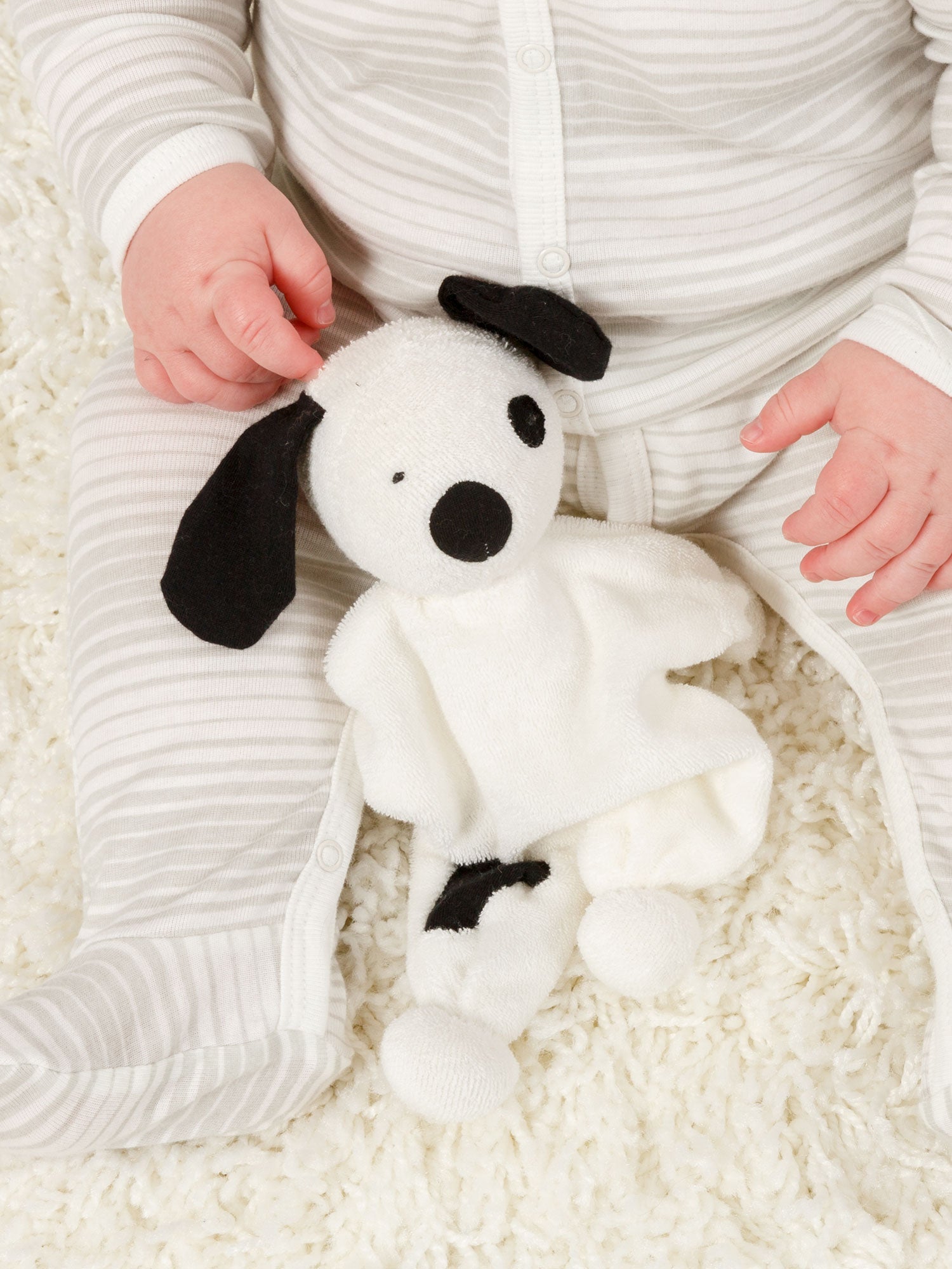
-
Tikiri Toys — natural rubber and organic cotton dolls and toys. A strong choice for the teething phase specifically.
-
Senger Naturwelt Cuddly Animals — German brand using organic cotton and wool filling. Higher price point but built to last years.
-
Sigikid Organic line — certified organic cotton and wool, designed for infants and young toddlers. Available through specialty toy retailers.

-
Bella Luna Toys — a curated retailer carrying Waldorf and Montessori-aligned brands made from natural materials. Good place to browse if you're not sure where to start.
-
Sarah's Silks — natural silk and wood-based play materials. Best for slightly older babies and toddlers doing more imaginative play.
If you're on a tight budget, start with Under the Nile and don't stress yet about upgrading every toy in the rotation. One safe mouthed toy is a better starting point than a complete overhaul that doesn't happen.
How to Make the Swap Without Losing Your Mind
Start with the toys that are mouthed most often
You don't need to audit the entire toy bin this week. Identify the two or three stuffed animals your baby reaches for during sleep, teething, or comfort-seeking. Those are the highest-exposure items and the ones worth replacing first.
Check the tag for fabric treatment language
Words like "stain-resistant," "water-repellent," "easy-clean," and "machine washable with protective coating" are signals that a fabric treatment may be present. A plain cotton or wool toy with no treatment claims on the label is a safer starting point.
Wash new toys before the first use
Even GOTS-certified toys benefit from a wash before they go into a baby's hands. Warm water and a fragrance-free, dye-free detergent removes any residual handling from packaging and shipping.
Start here this week: Identify the one stuffed toy your baby mouths most frequently. Check the tag for treatment language. If it lists any stain or water resistance, replace it with a GOTS-certified organic cotton option as your next toy purchase.
PFAS Exposure Summary by Toy Type
| Toy Type | Primary Concern | Risk Level During Mouthing | Safer Alternative |
|---|---|---|---|
| Plush with stain-resistant finish | PFAS fabric treatment | High | GOTS organic cotton plush |
| Vinyl/PVC soft doll | Phthalates, lead | High | Cotton-bodied doll |
| Plastic bath toy | Plasticizers, dyes, mold | High | Natural rubber bath toy (no hole) |
| Rubber bath toy with hole | Internal mold, bacteria | Moderate | Solid natural rubber teether |
| Untreated GOTS cotton stuffed animal | Minimal | Low | Already the safer option |
| Natural rubber toy | Minimal | Low | Already the safer option |
FAQ
Q: Does washing a stuffed toy remove PFAS from the fabric?
Washing can reduce surface chemical residue, but it doesn't remove PFAS that have been bonded to or embedded in fabric fibers through treatment. PFAS are specifically engineered to be durable and resistant to breakdown. That's the same property that makes them persistent in the body and environment. The more effective approach is to prioritize toys made without PFAS-based fabric treatments from the start. If a toy is labeled stain-resistant or water-repellent, repeated washing won't eliminate that treatment, and the fabric will continue to release compounds into saliva during mouthing.
Q: Are "BPA-free" labeled toys safe from PFAS?
No. BPA-free labeling only confirms the absence of bisphenol-A, one specific chemical compound. It says nothing about PFAS, phthalates, PVC content, or other chemical treatments applied to fabric or plastic. A toy can be BPA-free and still contain PFAS-treated fabric or vinyl components that carry their own risks. When evaluating stuffed toys specifically, look for GOTS certification or a natural rubber designation rather than relying on BPA-free claims, which address an entirely different category of chemical concern.
Q: My baby already has a favorite stuffed animal she won't sleep without. Do I need to take it away?
Progress over perfection applies here. If an immediate swap isn't realistic, you can reduce mouthing exposure by keeping the favorite toy accessible for comfort and sleep association without actively encouraging chewing on it, while gradually introducing a GOTS-certified replacement over a few weeks. Babies often accept a new toy more readily when it's introduced during calm, positive moments rather than as a direct replacement at bedtime. You don't need to cause distress over one toy. Reducing total exposure across all mouthed items is the goal, and each safer swap you make adds up.
About the Author
Jenn Smith, RN BSN, is a registered nurse, mom, and co-founder of Scrunchy Living. She writes evidence-based guides to non-toxic living, pregnancy-safe products, and clean home practices for modern families.
This article is for educational purposes only and does not constitute medical advice. Always consult your pediatrician or a qualified healthcare provider with questions about your child's health and chemical exposures.
Shop These Recommendations
| Product | Why It's Worth It | Amazon |
|---|---|---|
| Under the Nile | A brand offering GOTS certified organic cotton stuffed animals and toys. Safe for babies… | |
| Sigikids | (sigikid). A German toy brand offering an "Organic" line of soft toys and comforters made… | |
| Senger | (Senger Naturwelt). German brand making "Cuddly Animals" from organic cotton and wool… | |
| Tikiri Toys | A brand creating organic dolls and bath toys made from natural rubber and organic cotton. | |
| Sarah's Silks | A brand offering playsilks and wooden toys. Promotes open-ended, imaginative play using… | |
| Bella Luna Toys | A retailer specializing in natural, non-toxic, and open-ended toys. They carry Waldorf… |
From Scrunchy Living: The Non-Toxic Home Starter Kit ($75) replaces your household cleaners with one EWG Verified concentrate — quats-free, fragrance-free, and safe for pregnancy and babies. Includes a full year of ScrunchyAI, our ingredient-scanning tool for non-toxic families. Start your free 14-day trial →
You Might Also Like
- Non-Toxic Baby Toys & Gear: Teethers, Play Gyms, Bath Toys & Stuffies
- PFAS in Cookware: What Pregnant Moms Must Know
- Scrunchy All-Purpose Wipes — Our most-loved non-toxic cleaning essential — safe for babies, surfaces, and the whole family.